


How to Upgrade Builder-Grade Closets in New Langley Homes
 September 28, 2026
 Blog
Blog
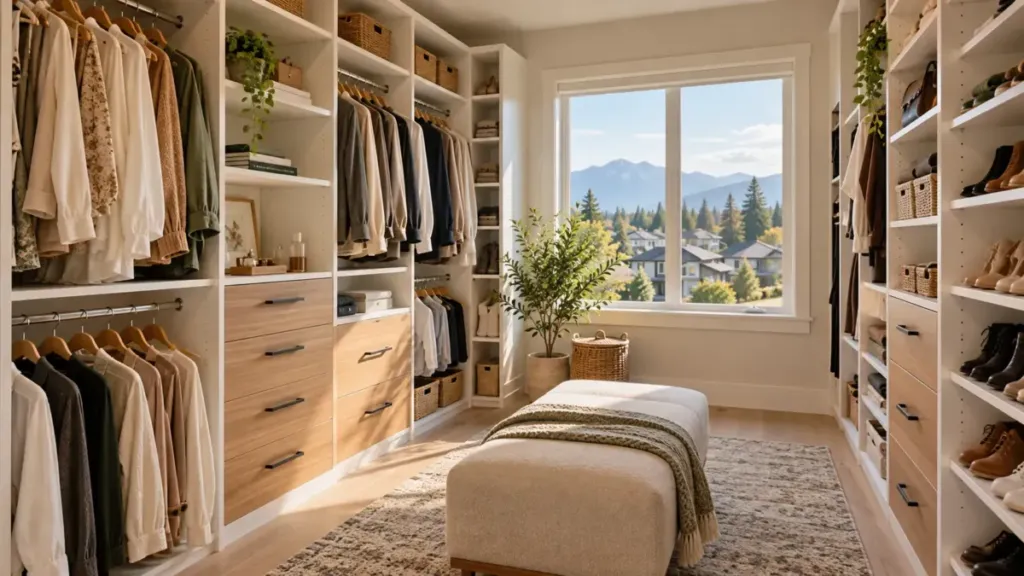
Congratulations—you have gotten the keys to your Langley residence. The kitchen is bright, the floors are clean, and the neighborhood is thriving. Then, you head to the master bedroom closet and find only a lone wire shelf and a single rod hanging on the wall. If this rings a bell, you’re not alone. In fact, throughout Langley’s newer neighborhoods, including Willoughby, Yorkson, Brookswood, and Walnut Grove, builders are delivering beautiful new homes with somewhat functional closets. Fortunately, builder-grade closet upgrade in Langley rank among the most effective home improvements you can undertake. This guide explains why standard closets don’t work in practice, how to better plan your closet layout, and how to select the best option for your budget and lifestyle.
What “Builder-Grade” Really Means
Builder-grade does not mean low quality. It means that the house is built at a particular cost and timeframe. Developers produce hundreds of homes, and closets are one of the areas where simplifying designs can save big bucks. Hence, most new homes will have the same arrangement, like
- One wire shelf and one clothes-hanging rod
- Rods at the same height that make most of the vertical space unusable
- Use of thin wire shelving, which leaves marks on folded garments
- Doors that are never convenient to use, for example, sliding or bi-folding
- Absence of drawers, shoe storage, and other organizing devices
- No illumination in the closet
The system is made to be “adequate” for the home show. It does not correspond to a real-life scenario, whatever it is, for instance, the needs of a growing family or the requirements of a person сarrying out business out of home.
Why Langley New Builds Need Smarter Closet Storage
Langley is home to some of the fastest-developing housing neighborhoods yet, and most of the recently constructed homes focus on maximizing space usage. The consequence of this is the existence of smaller bedrooms, shallow closets, and narrow entrances than what some people have gotten used to in older houses. Touching on the subject of homes, townhouses, and detached houses, which occupy thin plots, experience this more than anything else. Here are some things that make issues of new-build closet storage extremely vital:
Seasons. It is known that the weather in Langley varies significantly from rainy and wet winters to hot summers. Therefore, the abundance of required types of clothing in closets creates a problem.
Family life. Most of the homebuyers in Langley are young people with children. Various essentials, such as children’s clothing and backpacks, fill up closets really quickly, and this is not taken into account while building houses in the area.
Working from home. Nowadays, people more frequently work from home, and the need for a closet goes far beyond clothes kept in it.
Resale value. Properly designed closet space has great potential for resale.
Signs It’s Time to Upgrade
Don’t wait until your closet is impossible to get into. Here are some clear signs it’s time to improve your builder-grade closet:
- You don’t know what’s in the closet. If clothes are piled up, crammed, or lying over each other, you’ll always choose the same ones.
- The floor is full of junk. When you see shoes, bags, or laundry baskets on the floor, it shows there aren’t proper places for them.
- The top shelf looks like a rubbish bin. Wire shelves are usually hard to reach and don’t hold many smaller items.
- Getting dressed is stressful. You want your closet to save you time, not add more trouble to your morning routine.
- The wire shelves are bowing or snagging. Cheap wire shelves bend under weight and can also get stuck in knit clothes.
- You’re not happy with your current closet. If you are having a baby, moving in with someone, or changing jobs, your needs can change as well.
If at least two or three points fit your case, it’s advisable to think about renovating your closet.
Step 1: Audit What You Actually Own
Inventory everything before you buy anything to avoid a common mistake: designing a closet based on theoretical storage instead of actual needs.
To conduct your inventory, remove everything from the closet and sort it.
- Items requiring long hanging: coats, dresses, and robes
- Items requiring short hanging: folded pants, blouses, jackets, and shirts.
- Items requiring folded storage: jeans, sweaters, and tees.
- Shoes and boots.
- Accessories such as scarves, jewelry, hats, belts, and ties.
- Bags and luggage.
- Bulky items or off-season stock.
Next, make sure to measure the hanging items; find out how many linear feet of long-hanging and short-hanging ones you have. The inventory will tell you all you need about your closet needs, and the information is much better than any virtual template.
Also, while you carry out your inventory, it is a good idea to discard or at least store anything you haven’t put on for some time, such as two years.
Step 2: Understand Your Closet’s Dimensions
Each closet style has various advantages and drawbacks:
Reach-in closets. This type is very common in extra bedrooms. The shallow and narrow closets require us to take advantage of each inch in height. Double hanging, removable shelves, and clear drawers are good choices here.
Walk-in closets. These closets, appearing in larger bedrooms, usually provide a lot of options, but they are normally equipped with a similar basic grid template found in smaller closets. A customized version of the closet may feature an island, corner solutions, or full-height storage.
Pantry and linen closets. Although such closets are often overlooked, the principles of their design remain the same. Using adjustable shelving and pull-out organizers will improve their functionality a lot.
Entry and mudroom closets. In Langley, these are the places where wet boots, coats, and umbrellas land. Cubbies, hooks, and ventilated shelving will make a lot.
Make sure to measure the size of the closet, specifying the dimensions of its width, depth, and height, as well as checking the placement of all electrical sockets, flues, and switches.
Step 3: Choose Your Upgrade Path
There are three different ways to upgrade your standard closet. Each way is suitable for various budgets with a different level of ambition.
Option A: DIY Modular Kits
You can find modular kits in stores to assemble and apply them on your own. This is the least expensive solution, which suits only simple closets.
Pros: Low cost, flexibility, and quick installation
Cons: Limited size and number of finishes
Option B: Semi-Custom Systems
The semi-custom systems offer pre-made components that are cut to your closet’s specific measurements. This is a good compromise between price and personalization.
Pros: Good fit, more finish options, and higher-quality materials
Cons: Some restrictions when it comes to unusual shapes
Option C: Completely Custom Closet Organizers
If you choose a custom closet organizer Langley, it will be made based on your measurements, with cabinets, drawers, and other necessary things matched to your belongings. The installers can work with cases that have tricky ceilings, sharp angles, or some other “problems” that the “standard systems” cannot deal with.
Pros: Best utilization of the space, high-quality finishes, fitting your way of life, and increasing the property’s value
Cons: More expensive and takes more time
For many new-build owners, the best approach is to go custom in the primary closet, where daily use is highest, and use semi-custom or modular systems in secondary bedrooms.
Step 4: Design Features Worth Paying For
There are specific features that are worth the cost based on overall performance. Listed below are some features that have proven to be effective.
Double hanging. One of the features is double hanging, which means splitting the rod into two parts: the upper and lower parts. This feature enables the rod to carry larger amounts of clothing.
Drawers. This feature involves built-in drawers arranged in such a way that they cannot be seen but provide storage for items like undergarments and sportswear.
Adjustable shelving. This is a useful feature since it allows changing the shelf configuration.
Shoe storage. This feature provides better access to and visibility of the footwear.
Pull-out accessories. These accessories include racks, rods, and trays to organize small articles that take up too much space in a closet.
Lighting. Use of LED strip lights or motion-activated systems.
Use of wood or melamine shelves instead of wire shelving systems provides greater weight support.
Full-height storage featuring the off-season items that are only necessary for a closet and have to be kept properly labeled.
Step 5: Pick Materials That Last
Closet materials are important in terms of both durability and looks. Some common materials include
- Melamine (thermally fused laminate): Durable, easy to clean, and comes in various colors and wood-grain finishes. It is the most commonly chosen material for custom and semi-custom systems.
- Wood veneer: Attractive and stylish material suitable for closets that require a classy appearance, like main bedroom closets.
- Solid wood: The most expensive material and usually reserved for very luxurious projects.
- Wire: Cheap yet easily marked and sagging material. Best for utility closets like the laundry room or garage.
In the Lower Mainland’s humid climate, make sure to choose materials that can resist moisture, especially for the basement closets. It’s also important to have good ventilation, especially for keeping leather articles and shoes.
Room-by-Room Upgrade Ideas
- Master Bedroom Closet: Think about combining hanging rods, drawers, and footwear racks. If there’s space, think of including a compact table with drawers or a bench. A full-length mirror placed on the door or wall adds to the beauty of the closet.
- Children’s Rooms: Think about growth. Use adjustable shelves and rods that will assist the closet in reconfiguring from babies to adolescents. Low rods help young children dress by themselves, and the height is adjustable as they grow up.
- Guest Rooms: Make it simple and convenient. A hanging section, several shelves, and space for luggage make the room guest-suited without stuffing it too much.
- Entrance and Mudroom: Keep practicality and ventilation in mind. Hooks, a bench, ventilated shelves, and boot trays assist in dealing with the constant flow of wet devices.
- Linen and Pantry: Use adjustable shelves, pull-out baskets, and racks secured on the door so that this awkward space becomes useful and well-designed.
Budgeting for Your Closet Upgrade
Costs can differ a lot, owing to the size of the closet, the materials used, and the intricacy of the project. While:
- DIY modular systems tend to be the cheapest; a simple reach-in cupboard can be executed for a few hundred bucks.
- Semi-custom systems are in the mid-range category and vary by closet size.
- A fully custom system is the most expensive option, especially in the case of large walk-ins with cabinets, but it performs better.
You should make sure to get at least two to three quotations and find out what is included: design consultation, materials, installation, hardware, and warranty. It is also important to ask whether the quotation includes the removal of existing shelving and repairing drywall.
If your budget is limited, consider completing the project in stages. Begin with the main closet or the closet that causes you the most problems.
The Best Time to Upgrade in a New Build
The timing of doing something is very important. Most of the time, people wait for a long time, but sometimes there are good reasons for doing something in advance. For instance, the earlier you do it, the better the result will be.
One of the advantages of doing something early is that you can do it even before you unpack your luggage. That way, installation will be easier, as there won’t be so many things in your closet.
Another point is that it is much easier to do something when the drywall is still new. Fresh walls mean that you can avoid some repairs, and all the processes will be faster.
Lastly, doing everything at the beginning allows you to build good organizational systems. Yet, do not hurry and first spend some time in your new house. Inquire about the spots that will become cluttered and then think about the design of your closet.
Tips for Choosing a Langley Closet Company
When comparing closet service providers, consider a company that does the following:
- Offers an initial home appointment and measures your actual area
- Provides 3D drawings or design drafts before confirming any agreement
- Uses quality materials and hardware, like soft-close drawers and sturdy rods
- Knows the ins and outs of Langley homes and knows about closets in newly built houses
- Provides a straightforward quote with no hidden fees
- Assures their work and has customer reviews from the local area
- Completes the installation job properly and cleans after the installation
Common Mistakes to Avoid
- Forgetting about the inventory. A design that does not fit your belongings will not help you find a solution.
- Disregarding vertical usage. A large part of every closet build-out does not utilize the ceiling space.
- Building too much. Having more drawers and shelves does not always mean better—leave enough space for hanging clothing items.
- Leaving out the door. A better product could be made useless by bi-fold or sliding doors preventing access to the closet. It would be best to make use of a hinged or a barn door.
- Disregarding light. A dark closet defeats the purpose of good organization.
- Purchasing only for today. It is best to choose adjustable parts to allow for modifications.
Final Thoughts
What you need in a Langley home is for it to accommodate your lifestyle from the time you move in. You will, as many people are surprised, be surprised at how much your closet matters in this regard. If your builder upgrades your wire closet system, you will end up with a system that provides its benefits in the long term, like time savings and protection of your belongings.
Regardless of whether you opt for a minimalistic kit in the children’s area or go for a custom design in the master bedroom, the key thing is to consider how you use space. Gather the necessary information, measure accurately, identify what features are essential, and contact the locally-based professional.
Are you ready to start your project? Begin with the hardest closet that you have and see what a well-designed closet does for you.