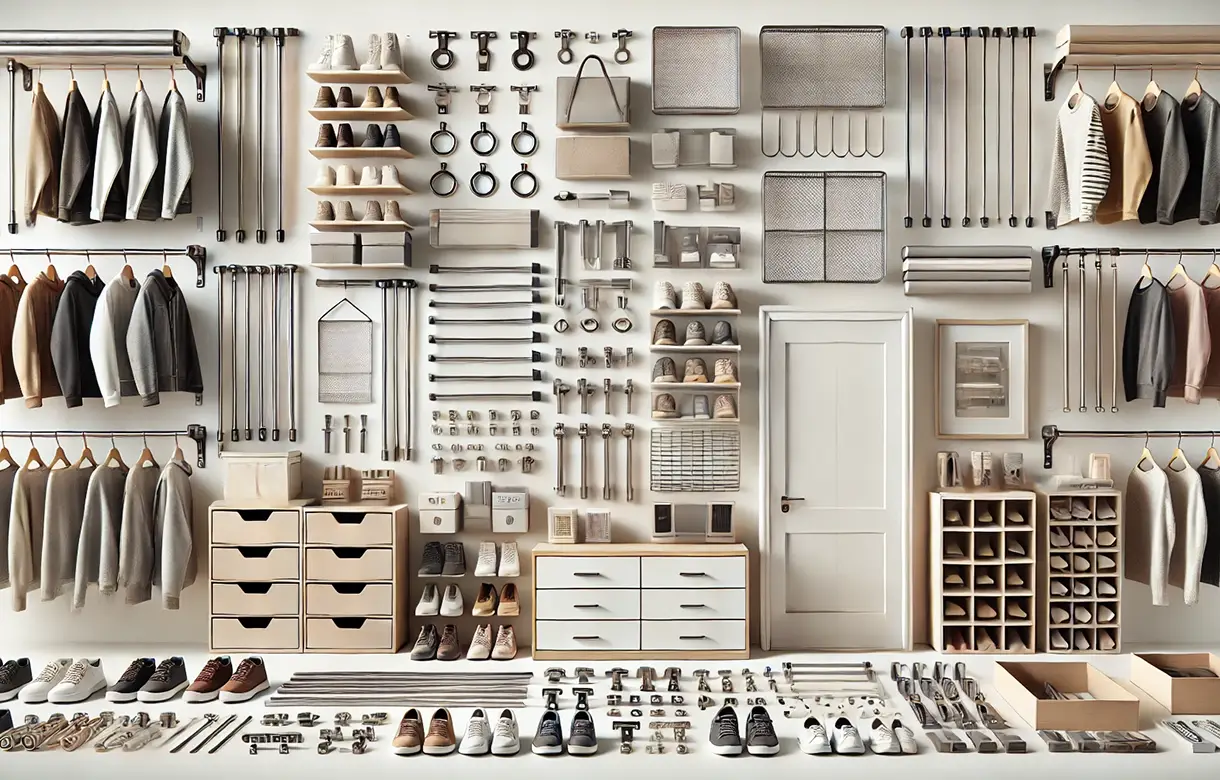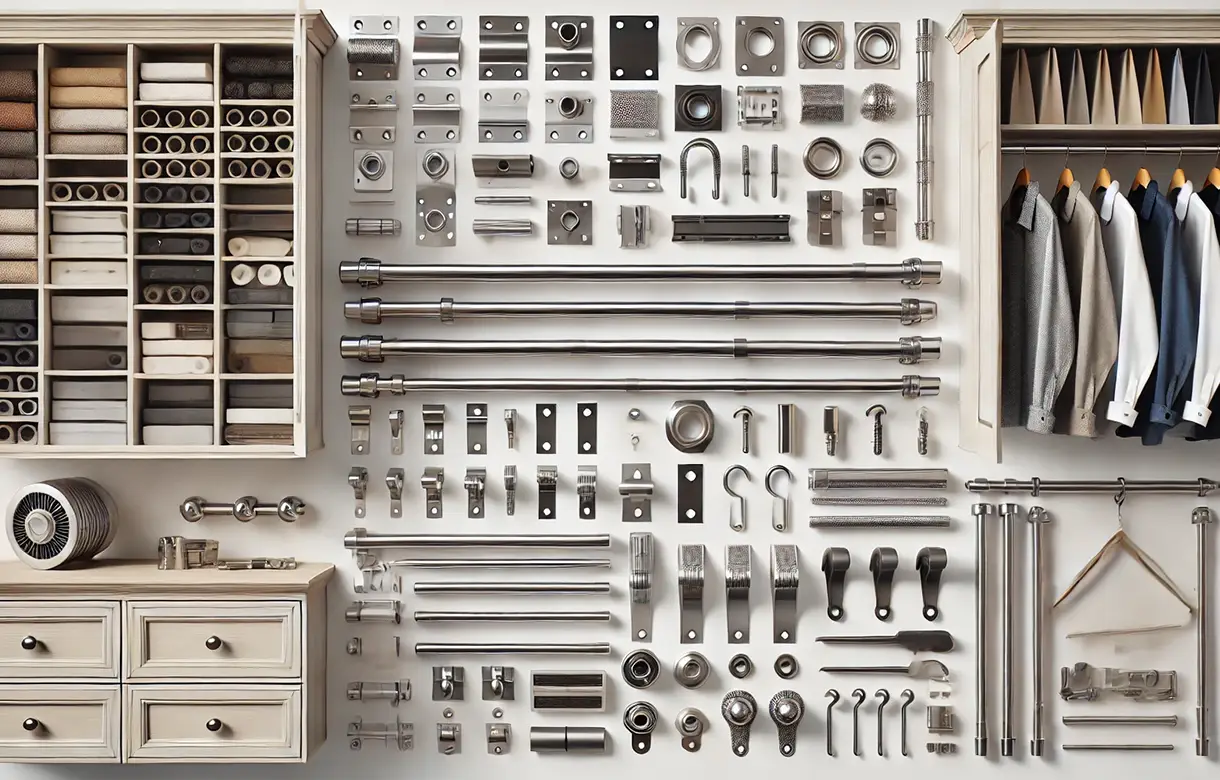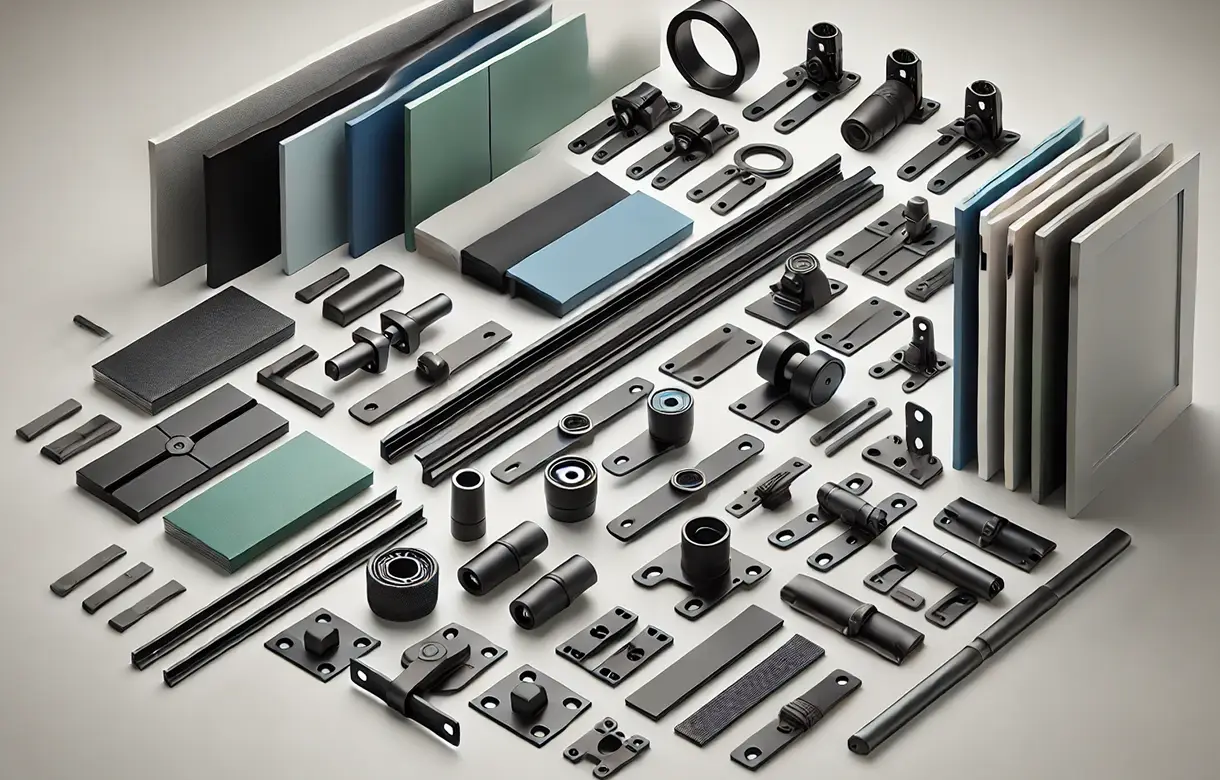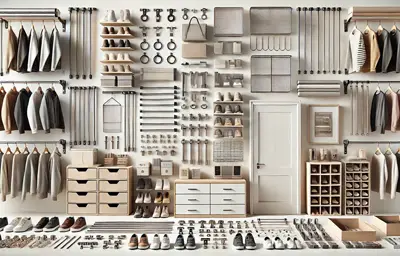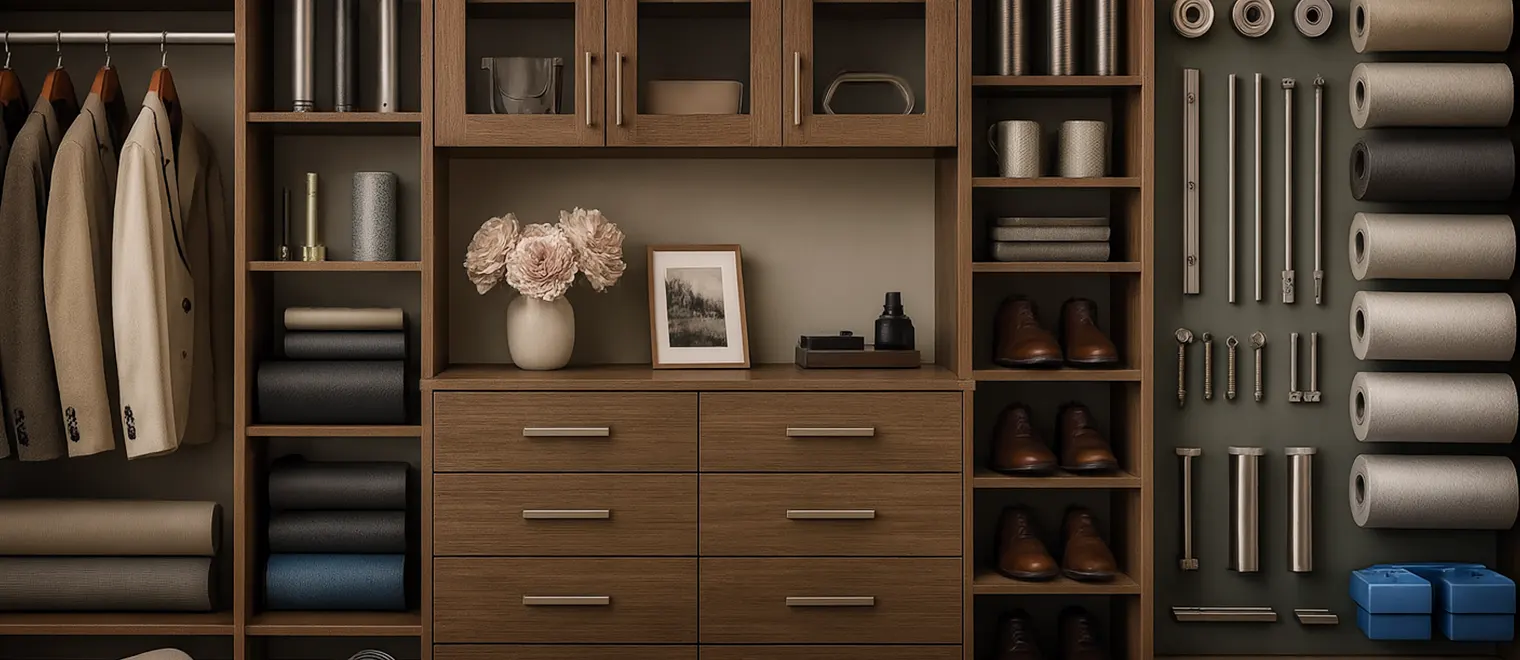
My Inspired Space supplies and fits closet hardware and accessories in Port Coquitlam — hangers, shelving, drawer systems, closet rods, hooks, baskets and bins, closet organizers, mirrors, belt and tie racks, towel warmers and drying rails. We use them on our own installations, and we sell them separately to people who want to improve a closet they already have. More than fifteen years in the Lower Mainland, and advice costs nothing.
Not every closet problem needs a new closet. A great many of them are hardware problems wearing a closet problem's clothes — a rod at the wrong height, a shelf too deep to see the back of, no drawer for the things that do not hang, and a floor of shoes because nothing was ever provided for shoes. Fix those four and the closet you already own often holds noticeably more without a single panel being replaced.
That is what this page is about. Closet accessories in Port Coquitlam are the lowest-cost, lowest-disruption way to improve storage, and they are worth trying before a full system for exactly that reason. A drawer unit, a second hanging rod and a shoe shelf cost a fraction of a rebuild and can be in place the same week.
There is a limit to it, and we will tell you when you have reached it. If the closet is fundamentally the wrong shape, or the existing structure will not carry what you want to hang from it, accessories will disappoint and a proper custom closet is the honest answer. Knowing which situation you are in is the most useful thing a free conversation can give you.
Closet hardware in Port Coquitlam falls into a handful of families, and the ones that change a closet most are rarely the ones people ask for first.
The single highest-return change in most closets. A standard closet has one rod at one height, which means the space beneath a row of shirts is doing nothing at all. Adding a second rod below turns one hanging section into two. Rods themselves vary more than people expect — diameter, wall brackets versus end sockets, and the span between supports, which is what determines whether a rod sags under a full load of winter coats.
Shelf depth decides whether a shelf works. Too deep and folded items get stacked front to back with the back row invisible and forgotten; too shallow and nothing sits securely. Adding an extra shelf into the dead band near the ceiling is usually free capacity, and replacing a single fixed shelf with adjustable shelving lets the closet change as what you own changes.
The thing most closets are missing entirely. Anything that does not hang and does not stack neatly — underwear, socks, activewear, swimwear, accessories — currently lives in a dresser somewhere else in the room, or in a pile. A drawer unit inside the closet consolidates that, and drawer inserts and dividers stop a deep drawer from becoming a single mixed layer. Graduated depths matter: shallow trays for small items, deeper drawers for knitwear.
Open storage that contains rather than conceals, which is what you want for anything grabbed quickly and put back carelessly. Baskets suit laundry, sports kit, hats and gloves; bins suit seasonal items on the high shelf; pull-outs make a deep or awkward section reachable rather than notional. All of them share one virtue: things go back, because putting them back is easy.
The specialist accessories that solve problems nothing else solves. Belts and ties either hang properly or they are a knot on a hook. A valet rod — a short pull-out rail for laying out tomorrow's clothes or holding items mid-change — is the accessory people are most surprised to find they use every day.
Hooks are the cheapest useful hardware there is, and the most under-fitted. Robe hooks, bag hooks and hooks on the inside of a door hold what would otherwise land on a chair. A mirror inside or on the closet gives you somewhere to check an outfit where the clothes are, and handles and pulls are the detail that makes an older system look considered rather than dated.
Shoes are the single most common thing found on a closet floor, and the floor is the worst place for them — they are hard to see, they collect the dust that everything else sheds, and they make the closet impossible to clean. Angled shelving displays shoes so pairs stay together and everything is visible at once; flat shelving takes more per shelf and suits boots and boxes; a low shelf that lifts shoes just clear of the floor is often enough on its own. The measure of success is whether the floor of the closet is empty afterwards.
Hangers are worth taking seriously — matching hangers of the right type genuinely increase capacity, because mismatched hangers force uneven spacing along a rod. And for laundry rooms and ensuites, towel warmers and drying rails handle what a Lower Mainland winter creates constantly: damp things that need somewhere to dry that is not a radiator or a door.
The second question is whether your existing closet can take it. A closet with sound sides and a solid back accepts most additions readily; a closet with only a rod spanning bare drywall may need a support added before anything else. That is a five-minute assessment and it prevents buying components that cannot be fitted.
Most disappointing closet accessories fail for one of two reasons. Either they did not fit the space, or they solved a problem the owner did not actually have. Both are avoidable, and both are avoided the same way: measure the opening, the depth and the existing structure, and identify the specific irritation you want to remove before choosing the part.
The measuring point is not fussiness. Closet openings vary, depths vary, and the difference between a drawer unit that slides in and one that is an inch too wide is entirely academic until you own the wrong one. The same applies to rod spans, shelf depths and anything that has to clear a door swing.
Beyond fit, quality shows up in a closet faster than almost anywhere else, because closet hardware is used every single day. Runners on a drawer opened twice daily, a rod carrying forty hangers, a hook holding a heavy bag — all of them are working harder than they look. Components chosen for that duty last; components chosen on price alone announce themselves within a year.
There is also a timing argument that people rarely consider. Accessories can be added in stages, which a closet rebuild cannot. That means you can solve the worst irritation this month, live with the result through a season, and decide whether anything further is genuinely needed — rather than committing to a complete specification for a closet whose demands you have not fully tested. Spreading it that way costs no more overall and produces better decisions, because each addition is made with the benefit of the last one.
The last argument is coherence. A closet that has accumulated parts from four sources over a decade looks like exactly that. Choosing components in one finish and one family makes an existing closet read as a system, which is a surprisingly large part of why a well-accessorised closet feels better to use.
The range covers hangers, shelving and shelf supports, drawer systems, closet rods and brackets, hooks, baskets and bins, closet organizers, mirrors, belt and tie racks, towel warmers and drying rails. Everything we install on our own closet projects is available separately for anyone who wants it for a closet they already have.
What comes with it is the part that saves money: advice on what will actually help. It is routine for us to talk somebody out of half the list they arrived with, because two well-chosen components frequently outperform six. If the honest answer is that accessories will not fix the problem, we say so.
Whether a specific component suits a closet we did not build depends on that closet — the opening, the depth, the existing structure and, for anything replacing part of a proprietary system, the system itself. Photographs and a few measurements settle it quickly, and that check happens before anything is ordered rather than after.
The useful question is not what accessories exist — it is what goes wrong in this closet every morning. Things on the floor mean something has no home. A crowded rod means the hanging is under-provisioned or badly divided. A shelf you cannot see the back of means the depth is wrong for what is on it. Each symptom points to a different component, and buying against the symptom rather than against a catalogue is what separates accessories that get used from accessories that get moved to the garage.
Width of the opening, depth from front to back, and height available in the section you want to change. Then the constraints around them: which way the door swings and how far it opens, whether anything projects into the space, and how the existing shelf or rod is supported. Those six numbers answer almost every compatibility question before it is asked.
An accessory only works if it is easier than the bad habit it replaces. If clothes end up on a chair every evening, a valet rod or a couple of hooks will be used and a drawer will not. If shoes are kicked off at the closet door, open shelving at floor level will be used and a lidded box will not. Be honest about the habit rather than the intention — the accessory that suits how you actually behave is the one still in use next year.
Adjustable and repositionable components are worth a small premium, because closets outlive the arrangement they were set up for. Children grow, wardrobes change with a new job, and seasons rotate. Adjustable shelving, rods that can be relocated and drawer inserts that lift out mean the closet adapts instead of needing another intervention in three years.
Closet hardware goes wrong in small, cheap, repetitive ways, which is precisely why so many closets contain several of them at once.
Fixing a rod or a shelf into drywall alone is the most common, and the most predictable. It holds while the closet is half full and fails the first time it carries a season's worth of coats. Rods and shelf supports belong in structure, and where there is none in the right place, something has to be added to carry the load.
Buying before measuring is the next, and it is the reason so many drawer units end up in garages. An inch of width is the difference between a component that slides into an opening and one that does not, and no amount of good design compensates.
Then there is over-accessorising. It is genuinely possible to fit so many organizers into a closet that the closet holds less than it did — every divider, insert and rack occupies volume, and past a point they consume more than they organise. Two well-chosen components usually beat six.
Mixing finishes and families is a quieter one. Chrome, white, black and timber in the same small space makes an otherwise decent closet look accumulated rather than designed, and it is entirely free to avoid by deciding on one family at the outset.
Ignoring the door is a small mistake with daily consequences. A bifold or a sliding door limits how much of the closet is reachable at once, and hanging a valet rod or fitting a pull-out where the door blocks it produces a component that technically exists and practically does not. Checking what the door actually gives access to takes a moment and changes where things should go.
And the most expensive mistake in this category is treating hardware as a fix for a structural problem. Accessories cannot correct a closet that is too shallow for its purpose, a door that blocks half the opening, or a system whose panels are failing. Money spent on components in that situation is money spent twice, and it is worth someone telling you so before you spend it.
Photographs of the closet and a rough idea of what irritates you daily are usually enough to start. We will tell you whether this is an accessories job or whether the closet needs more than components can give it. That answer is free and it comes before any recommendation.
Width, depth and available height, plus the door swing and how the existing shelf or rod is supported. Against those numbers we recommend the components that fit and suit the way the closet is used — usually fewer than people expect.
You can take the components and fit them yourself, or we can install them. Anything carrying real weight — rods, shelf supports, wall-hung units — is worth having fixed into structure properly rather than into drywall.
Accessories are incremental by nature. Start with the two changes that solve the daily irritation, live with it for a season, and add more if it is still needed. Plenty of customers never need the rest.
Three questions decide whether a component works in an existing closet, and all three are answered before anything is ordered.
The first is what carries the load. A closet rod loaded with winter coats, a shelf carrying stacked bins, or a wall-hung drawer unit all impose real weight, and the fixing has to reach structure — a stud, a solid closet side, or a support added for the purpose. Where the existing closet is a rod spanning bare drywall between two brackets, adding capacity means addressing that first. It is a small piece of work and it is the difference between an improvement and a repair.
The second is span and support spacing. A rod's diameter and the distance between its supports determine whether it stays straight under load, which is why a long single-span rod in a wide closet sags in the middle regardless of how well it was fitted. An intermediate support solves it. The same logic applies to shelving, where the span between supports and the shelf material together decide the sag.
The third is clearance. Every component has to clear something: the door as it swings, another drawer as it opens, the hanging garments in front of it. Pull-outs, valet rods and drawer fronts all need a defined space to move into, and checking that is the difference between a component that works and one that is technically installed.
There is one more consideration specific to retrofitting: what the component is being fixed to. In a purpose-built system the panels are engineered to accept hardware; in an older closet the side may be a stud wall, a finished panel, or simply drywall returning into the opening. Establishing that before ordering avoids the most frustrating outcome of all, which is owning a component that suits the closet perfectly and cannot be attached to it.
Beyond those, the choices are about longevity: runners and hinges rated for daily use rather than occasional, finishes kept to one family, and adjustable components wherever the closet's contents are likely to change — which, in most households, is all of them.
Four existing situations account for nearly all of this work, and they follow the age of the home more closely than the neighbourhood.
The first is builder wire shelving, which is what almost every newer townhouse and condo through Dominion Triangle, Fremont and the developments north of the Coquitlam River was handed over with. A single wire shelf with a rod beneath it wastes most of the closet, and it is also the easiest situation to improve — a second rod, a drawer unit and shoe shelving transform it without touching the wire at all.
The second is the original single rod-and-shelf reach-in, standard in the pre-1970s houses around Central Port Coquitlam, Birchland Manor and Lincoln Park. These closets were built for wardrobes far smaller than modern ones, so the wins come from vertical planning: double hanging where the garments are short, an added shelf in the dead band at the top, and drawers to take what a dresser is currently holding.
The third is the ageing melamine system, common through Citadel Heights, Mary Hill and the streets off Coast Meridian where systems were installed in the 1980s and 1990s. The carcass is frequently sound while the hardware is tired and the layout no longer matches the household. New runners, updated handles, added drawer inserts and a rearranged rod give another decade from a system that looked due for replacement.
Two things cut across all four. Port Coquitlam has a high proportion of homes with secondary suites, and suite closets are almost always the last storage in the house to get any attention — usually a single rod in a small opening, and usually the closet where a few components make the largest proportional difference. And the region's damp winters mean drying rails and towel warmers come up here far more often than they would in a drier climate, because wet coats, boots and sports kit need somewhere to dry that is not a bedroom door.
The fourth is adding to a system we installed ourselves, sometimes years earlier. Wardrobes change and households change, and adding a drawer insert, a valet rod or another shelf to an existing My Inspired Space closet is straightforward because we know exactly what is there.
We cover Port Coquitlam, Coquitlam and Port Moody, plus Pitt Meadows, Maple Ridge, Langley, Burnaby, New Westminster and Vancouver.
A closet rod and brackets are typically [VERIFY]. A drawer unit is [VERIFY], shoe shelving [VERIFY], a valet rod [VERIFY], and baskets or pull-outs [VERIFY]. Installation is [VERIFY - included / charged separately / minimum call-out].