My Inspired Space supplies and installs garage slatwall panels across the Lower Mainland — PVC and aluminum panel systems screwed through the drywall into the studs, finished at the edges, and loaded with hooks, baskets and shelf brackets chosen for what your household actually owns. Fifteen-plus years of local installs, a 3D rendering before anything is ordered, and a free in-home consultation to start.
Slatwall is the one storage product where the wall itself becomes the system. Instead of deciding today where each hook and shelf will live forever, you install a field of horizontal grooves and decide later — then change your mind in thirty seconds, without a drill, as many times as you like. That single property is why it has taken over the garage category: a garage holds bikes in summer and skis in winter, and slatwall is the only format that shrugs at the swap.
But "slatwall" covers a wide range of products, and the differences between them are exactly the kind that do not show up in a photo. Panel material determines how much each groove can carry and how it survives a damp, unheated garage. The accessory ecosystem determines whether you can still buy a matching bike hook in six years. The mounting method determines whether the rated capacity means anything at all. This page exists to walk you through those decisions honestly, because we install the product and we also talk people out of it when a simpler answer would serve them better.
If you are researching wall-mounted storage more broadly — shelving runs, floating cabinets and rail systems through the whole house — our wall storage page covers the full category. This page is narrower on purpose: it is about the grooved panel product, for the garage, and about choosing it well.
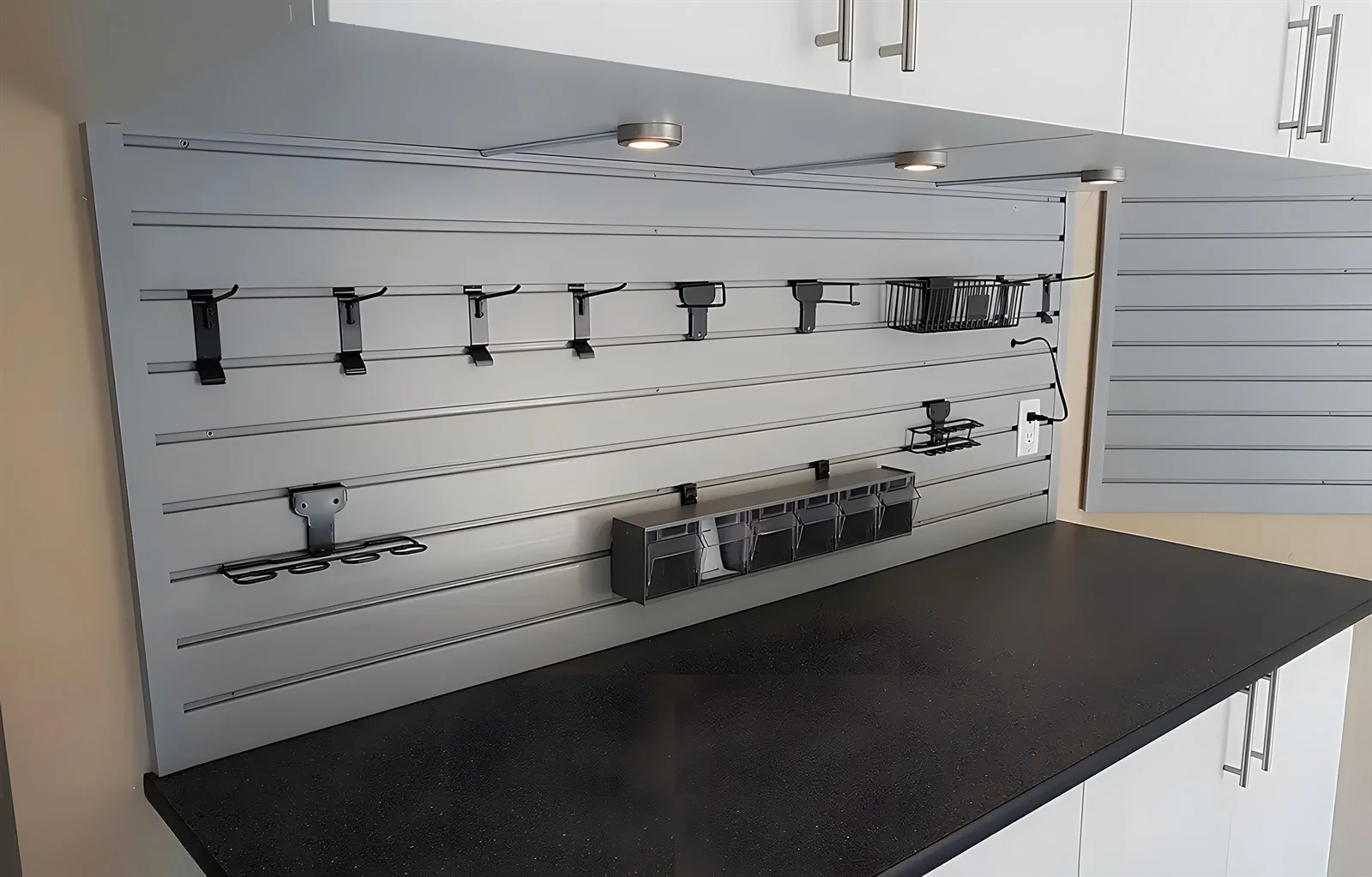
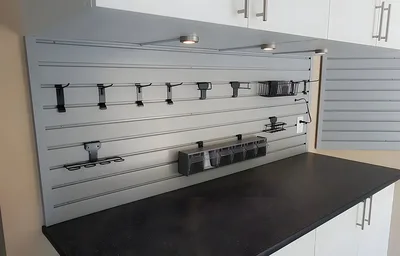
The groove is the clever part. Each accessory — hook, basket, bracket, bin rail — ends in a lip that drops into the slot and cams against the inside of the T. Gravity holds it seated; the harder something pulls down on the hook, the harder the lip presses into the groove. Lift the accessory slightly and it comes free. That geometry is what gives slatwall its two defining behaviours: nothing needs a fastener, and everything can move.
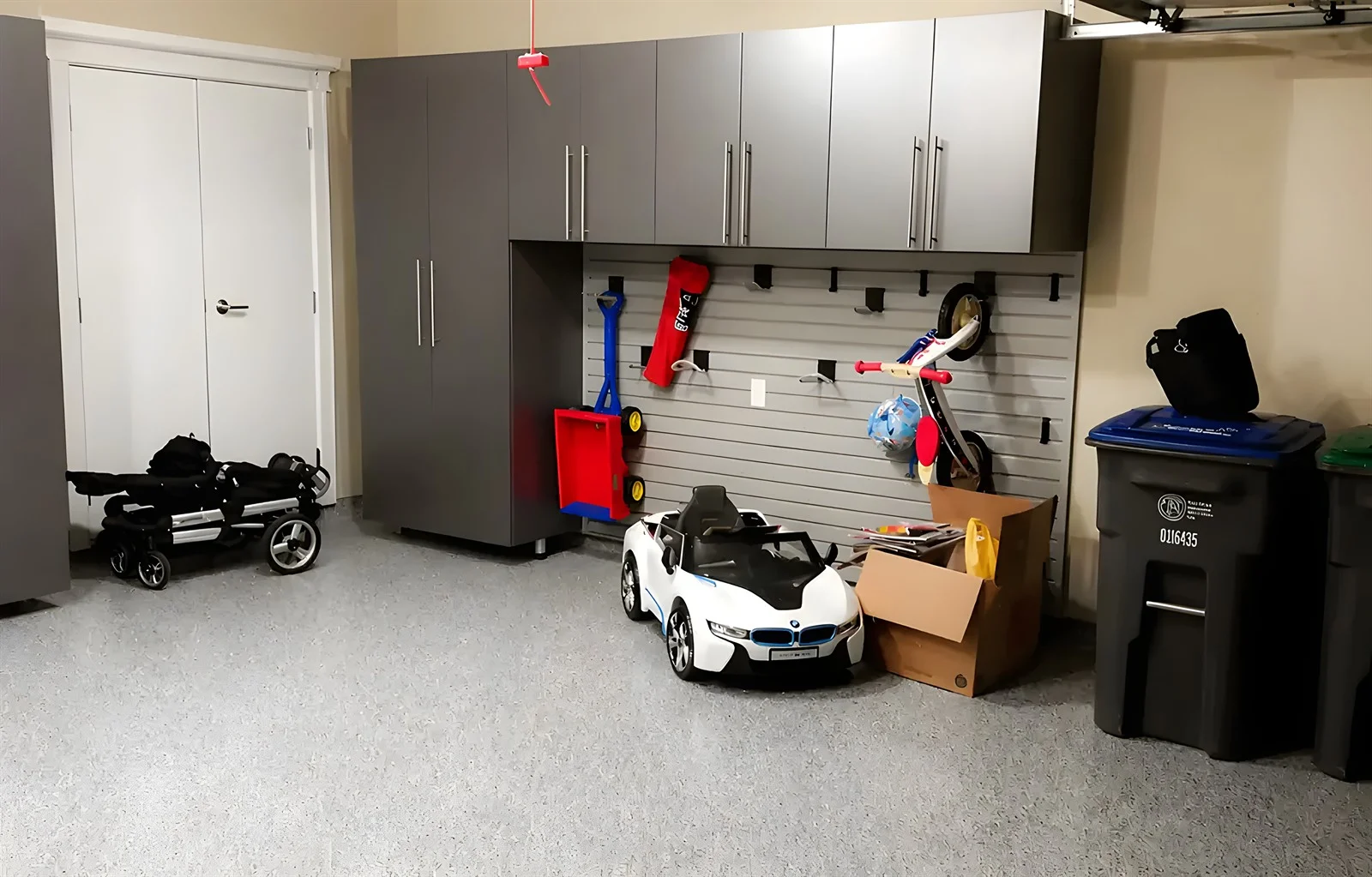
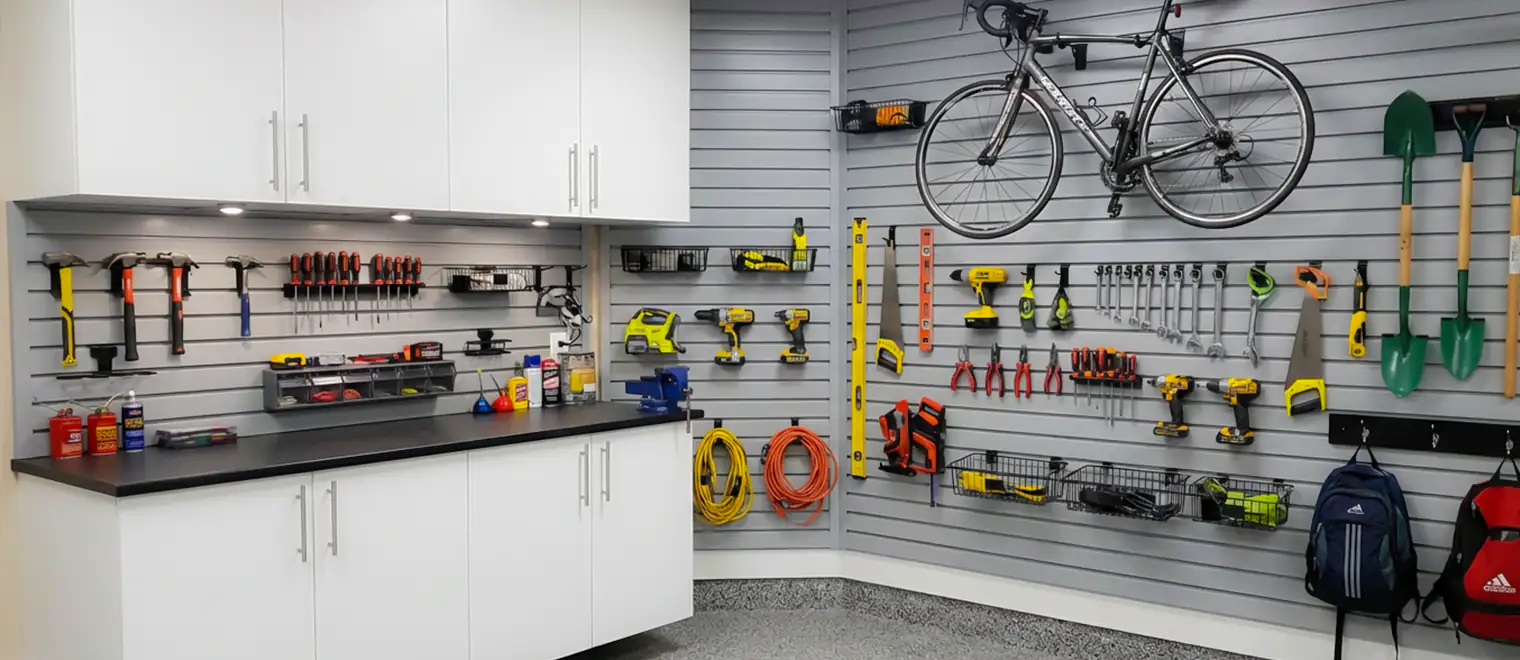
Garage panels typically come in 12-inch or 15-inch heights with grooves every three inches, and run in courses across the wall. You can panel a full wall floor-to-ceiling, or run a band — say, the middle four feet where hands can reach — and paint the rest. Bands cost less and cover most storage needs; full walls look cleaner and give you the ceiling-height real estate for long-term hanging like ladders and kayaks. Both approaches are legitimate, and the choice is mostly budget against ambition.
What the grooves will not forgive is a casual install. A panel is only a bridge between its screws, and every pound on every hook travels through those screws into the framing behind. The product's whole value rests on that path being solid, which is why we treat mounting as the first design question rather than the last installation detail.
Extruded PVC is the default garage slatwall for good reason. It cannot rot, rust or swell, which matters in a Lower Mainland garage where a wet car drips road spray all winter and the space may never see a heater. It wipes clean, it comes in several colours so the wall reads as a finished surface rather than a fixture, and per square foot it is the most affordable way to groove an entire wall. Its limit is concentrated load: PVC grooves flex, and a heavily loaded single hook works the slot over time. Distributed across many accessories, a PVC wall carries a remarkable total; asked to hold one very heavy thing on one hook, it is the wrong choice.
Extruded aluminum grooves do not flex, so the per-hook numbers climb dramatically — this is the panel for the household hanging two e-bikes, a canoe and a scaffold plank from individual accessories. Aluminum is also the pick for a working shop wall where accessories get slammed in and out daily, because the groove edges shrug off the abuse that slowly chews a softer panel. The costs are the obvious one and a quieter one: the price per square foot is well above PVC, and the material reads industrial, which some owners love and some find cold.
Wood-fibre slatwall dominates retail shopfitting, and people sometimes arrive having priced it. We rarely put it in a garage. MDF drinks moisture through any cut edge, and its grooves depend on metal inserts to carry meaningful weight; in a dry, heated, finished garage it can work, but the Lower Mainland does not supply many of those. If the budget is tight, a narrower band of PVC beats a full wall of MDF in this climate almost every time.
The materials share groove geometry closely enough that a hybrid wall is often the smart buy: aluminum courses at bike-and-ladder height where the brutal loads hang, PVC everywhere else. You pay the aluminum premium only for the twelve linear feet that need it. This is the layout we end up drawing most for families with a fleet of bikes.
Every slatwall brand sells the same first impression — a wall of grooves and a starter bag of hooks — and the differences only surface later, when you go back for more. A strong ecosystem offers single hooks in a dozen reaches, double-arm hooks for shovels and hoses, vertical and horizontal bike hangers, ball bins, wire baskets in graduated depths, shelf brackets that take a plank or a wire shelf, paper-towel holders, tool clips sized to actual tools, and locking variants of most of the above. A weak ecosystem offers hooks. You discover which you bought at the moment you try to hang a specific thing and the catalogue shrugs.
Groove standards are mostly, but not perfectly, interchangeable: the common 3-inch-on-centre T-slot accepts most brands' accessories, while some proprietary systems lock you into one manufacturer's parts at one manufacturer's prices. We specify panels on the open standard precisely so that ten years from now, any of several catalogues will still fit your wall — including whatever the accessory makers invent between now and then.
Our own range of hooks, baskets, brackets and specialty hangers lives on the hardware and accessories page, and at the design visit we do something slightly unusual: we inventory what you own — the bikes, the strollers, the golf bags, the six shovels — and spec the accessory list to the actual objects. A slatwall quoted without an accessory list is half a quote.
Capacity questions come in two forms, and they have different answers. Per-hook capacity is governed by the groove: what one slot can hold before the lip deforms or the panel face flexes. This is where aluminum outruns PVC. Whole-wall capacity is governed by the fixing: the sum of everything hanging travels through the mounting screws into the studs, so the total is a function of how many screws found framing and what that framing is.
Most finished garages have drywall over studs, and slatwall goes over the drywall — no demolition, no patching, install in a day. The drywall contributes nothing structurally; it is simply the layer the screws pass through on their way to the wood. We locate every stud before the first panel goes up, snap lines, and fasten each course into every stud it crosses. On a bare-stud garage wall the job is even simpler, and on a concrete or block wall the panels take masonry anchors instead. Each substrate is fine; each has its own fastener, and the fastener is chosen at the measure, not improvised on the ladder.
Two honest cautions belong here. First, dynamic load: yanking a mountain bike off a hook applies a multiple of its hanging weight, so anything lifted and dropped frequently should be specced with margin, not at the limit. Second, adhesive and cleat-only installs marketed as "no-drill" put the entire system's fate in the drywall's paper face. We will not install that way, and we would encourage you not to accept it from anyone.
The case for slatwall is rotation. If your garage wall will hold roughly the same things in roughly the same places for years, a fixed shelf run or a bank of cabinets does the job for less money and hides the clutter besides. But if the wall's contents cycle — hockey bags giving way to camping gear giving way to Halloween bins — then every fixed system slowly drifts out of date, while a grooved wall just gets rearranged on a Saturday morning.
The case against slatwall is boxes. A hook cannot hold a Rubbermaid tote, and a wall of grooves stacked with shelf brackets is an expensive way to build shelving. Households whose storage is mostly binned belong with garage cabinets for the closed storage and overhead storage for the seasonal totes, with perhaps a short slatwall band by the door for the daily grab-and-go items. Slatwall is also a display format — everything on it is visible — so owners who want the garage to read tidy at a glance usually want doors somewhere in the plan.
Inside the house, slatwall usually loses to rail systems on appearance: grooves read as workshop, and a pantry or office wants storage that reads as furniture. That comparison, and the rest of the whole-home picture, lives on our wall storage page. And when the real project is the entire garage — floor, cabinets, ceiling racks and walls planned as one — start from garage storage, where slatwall becomes one instrument in the orchestra rather than the whole band.
A designer measures the wall, locates and marks the studs, notes the substrate — drywall, bare framing or concrete — and walks the garage with you listing everything that needs to hang. Ten minutes with the bikes and shovels tells us more than an hour with a catalogue. Free, and you are not committed to anything.
You see the panelled area rendered on your actual wall dimensions: band or full wall, PVC or aluminum or a hybrid, colour, and every accessory placed where it will live. Move the band higher, swap materials, add a basket column — revisions cost nothing. The quote itemizes panels, accessories and installation.
Panels and the accessory list are ordered to the approved drawing. Trim, end caps and colour-matched screws come with them, so the finished wall has no raw edges or visible fastener heads.
Our crew fastens every course into the framing on the manufacturer's screw schedule, levels each panel — grooves telegraph any error straight across the wall, so level is non-negotiable — fits the trim, and hangs your gear on the accessories before we leave. A typical single-wall install finishes in under a day.
A garage here spends half the year damp. Cardboard on the floor wicks and collapses, steel left against concrete blooms rust, and anything stored at slab level eventually pays a moisture tax. Getting gear onto the wall is not just organization in this region; it is preservation. It is also why our material advice tilts so hard toward PVC and aluminum — the two slatwall materials that treat a wet November as a non-event.
The housing stock shapes the work too. The double garages of the region's 1980s and 1990s subdivisions usually offer one long uninterrupted wall that takes a full slatwall field beautifully. Newer small-lot homes and townhouses trade floor area for height, which pushes the design upward — taller panel fields, long-object hanging turned vertical, and slatwall paired with ceiling racks. Acreage properties out the valley often want the opposite: a workshop wall in aluminum, specced like a trade space rather than a family garage.
We install garage slatwall in Pitt Meadows, Maple Ridge, Coquitlam, Port Coquitlam, Port Moody, Langley, Surrey, Burnaby, New Westminster and Vancouver. The four city pages below go deeper on what we find in each market.